Does a Joint Really Hurt Your Cueing? 3/4 vs One-Piece Cues, Honestly Assessed
· Mark O'Sullivan
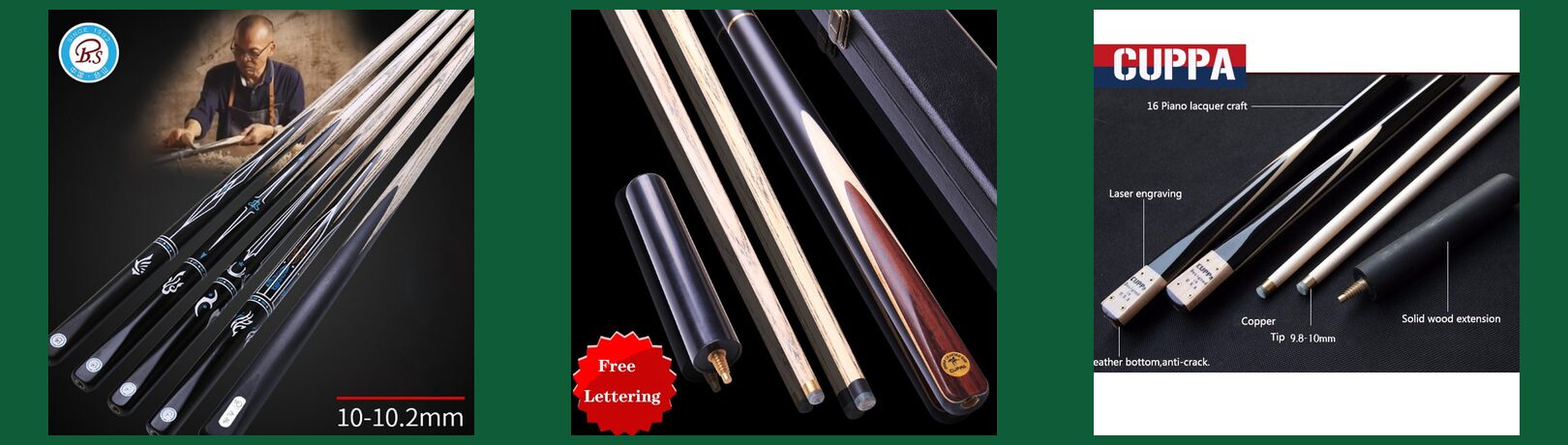
Ask around a snooker club and you'll hear the same worry from anyone thinking of buying a 3/4-jointed cue: won't the joint spoil the feel of the shot? It's a fair question, and it deserves an honest answer rather than the usual marketing hand-waving. So let's actually pull the two designs apart — feel, myth, storage and travel — and work out which is right for you.
What we're actually comparing
A one-piece cue is a single length of timber (usually ash or maple) from butt to tip, typically around 57 inches. A 3/4-jointed cue splits roughly three-quarters of the way up, with a brass joint bringing the two halves together. There are also 1/2-jointed cues that split in the middle, but for serious snooker the 3/4 split is the popular compromise — most of the shaft stays intact, and only the butt end unscrews.
The big question: does the joint kill the feel?
Here's the honest verdict. On a well-made 3/4 cue with a tight, flush joint, the vast majority of players cannot feel a meaningful difference in normal play. The joint sits well behind your bridge hand and behind most of the vibration path, so the tip-to-object-ball feedback you actually notice comes from the front of the shaft — which is unbroken.
Where the myth has some truth is at the extremes. On a cheap or poorly cut joint, you can get a slight "dead" spot or a faint buzz on powerful shots, because the two halves aren't mating perfectly. That's a quality issue, not an inherent flaw of the design. A good one-piece cue removes that variable entirely — there's simply nothing to go wrong. If you're a purist who plays daily and wants the most direct, uninterrupted hit possible, a solid one-piece like the BS New Arrival One Piece Billiard Snooker Cue Stick 10.2mm Tip with Hard Snooker Cue Case Set is a genuinely lovely thing to cue with.
Where the jointed cue wins: real life
The trouble with a 57-inch one-piece cue is that it doesn't fit into a car boot, a train luggage rack, or a cupboard without drama. A 3/4-jointed cue breaks down to a compact length that slips into a proper case, which is why club and travelling players overwhelmingly favour them. If you commute to your table, take your cue to a mate's house, or simply want to store it safely out of the way, the jointed design just makes life easier.
Jointed cues also open up extra options. Many come with a matching butt extension for reaching long shots, such as the Handmade Cuppa 3/4 Snooker Cues Sticks 9.8mm Tips With Extension Ebony Wood Handle China Anti Cracking Lacquer Craft, and often use attractive spliced hardwood butts that would be harder to justify in a single length of timber. A well-rounded starter option like the NEW Cuppa 3/4 Snooker Cues Stick 9.8mm 11.5mm Tip with Snooker Cue Case Set typically arrives with a case included, which is exactly what a jointed cue needs to travel safely.
Don't fancy a joint? Fix the reach problem another way
The one genuine disadvantage of a one-piece cue in normal play is reach on long shots. You don't have to abandon the design to solve that — a simple telescopic add-on like the Snooker Cue Extender Adjustable Length Telescopic Cue Extension clips onto the butt when you need extra length and comes off again in seconds. It's an inexpensive way to keep the one-piece feel while dealing with those awkward stretches over the baulk cushion.
What about carbon and modern builds?
It's worth noting the debate isn't strictly wood versus wood any more. Jointed cues now include composite options such as the CUPPA New Arrival Little Monster Carbon Billiard Snooker Cue Stick 10.2mm Tip with Snooker Cue Case Set, which prioritise consistency and resistance to warping. Whatever the material, the same principle holds: build quality at the joint matters far more than the mere presence of a joint.
Quick comparison
A realistic word on budget cues
Most cues in this bracket are affordably priced, imported and hand-finished, so set your expectations sensibly. You may need to re-fit or true a tip, and the odd cue benefits from a light burnish before it plays its best. At the very bottom end, something like the 2 Pcs 145cm/57inch American Snooker Wood Pool Cue Assemble Children Adult Home Billiards Exercising Entertaining Tools Supply is fine for casual home knockabouts but isn't pretending to be a match cue. Pay a little more and you generally get a straighter shaft, a better joint and a nicer finish.
So which should you buy?
- Choose one-piece if you have somewhere to store and transport it safely, play mostly at one table, and want the simplest, most direct hit with nothing to work loose.
- Choose 3/4-jointed if you travel with your cue, want a compact case, like the option of an extension, or simply value convenience — and buy from a maker who cuts a proper joint.
The joint itself is not the enemy. A cheap joint is. Match the cue to how and where you actually play, buy the best build you can afford, and you'll barely think about the split again once the balls start dropping.