3/4-Jointed vs One-Piece Cues: Balance, Bag Space and the Honest Trade-Offs
· Mark O'Sullivan
Ask ten club players whether a 3/4-jointed cue plays as well as a one-piece and you'll get ten opinions, usually delivered with great confidence. The truth is calmer than the pub debate suggests. Both formats can play beautifully, and the right choice comes down to how a cue balances in your bridge hand, where you keep it and how far you carry it. Let's cut through the folklore and look at what actually changes when you put a joint in a cue.
What the joint really does (and doesn't) do
A one-piece cue is exactly that: a single length of timber from butt to tip, usually around 57 inches. A 3/4-jointed cue splits roughly three-quarters of the way up, so the shorter joint sits well above your grip and bridge hand during a normal shot. That placement matters. Because the joint isn't under your fingers or in the striking zone, a well-made 3/4 cue transmits feedback that most players struggle to tell apart from a one-piece in blind testing.
Where the joint does make a difference is in balance and mass. A brass joint adds a little weight and can nudge the balance point back towards the butt. That's not automatically bad — many players like a slightly butt-heavy feel — but it's the honest, physical difference behind most "it just doesn't feel the same" complaints.
The case for one-piece cues
If you have a dedicated cue rest at home, or you play at one club where you can leave a cue in a locker, a one-piece is a genuinely lovely thing to own. There's no joint to work loose over years of screwing and unscrewing, and the weight distribution is uninterrupted. Purists like the continuity, and there's simply less to think about.
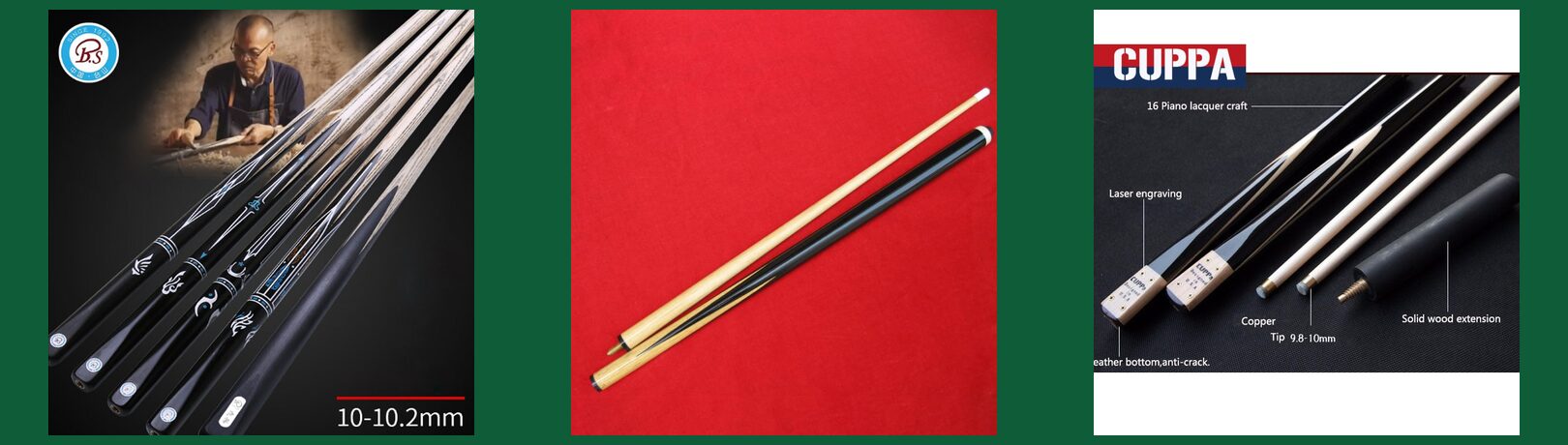
Something like the BS New Arrival One Piece Billiard Snooker Cue Stick 10.2mm Tip with Hard Snooker Cue Case Set shows the format at a more serious level, arriving with a hard case that solves the one obvious downside — a full-length cue is awkward to move and vulnerable in transit. At the budget-and-beater end, the 2 Pcs 145cm/57inch American Snooker Wood Pool Cue Assemble Children Adult Home Billiards Exercising Entertaining Tools Supply is a cheap way to keep spare cues by a home table for guests, though don't expect refined feel from inexpensive imported timber.
The case for 3/4-jointed cues
For most people who travel to play, the 3/4 wins on sheer practicality. It packs down to fit a normal aluminium or padded case that slips into a car boot, onto a train luggage rack or over your shoulder without turning heads. That convenience means the cue actually comes with you, which does more for your game than any marginal feel debate.
Better still, the format pairs naturally with extensions. The Handmade Cuppa 3/4 Snooker Cues Sticks 9.8mm Tips With Extension Ebony Wood Handle China Anti Cracking Lacquer Craft bundles an extension so you can reach long shots without fetching the rest cue every frame, and the ebony handle gives a reassuringly solid feel in the grip. For a straightforward first jointed cue with a case, the NEW Cuppa 3/4 Snooker Cues Stick 9.8mm 11.5mm Tip with Snooker Cue Case Set covers the essentials at a sensible price.
A quick honest comparison
These are affordable, mostly imported cues. They represent good value rather than hand-turned exhibition pieces, so set your expectations accordingly and check the tip and ferrule when yours arrives.
How to decide in five minutes
- Do you travel to play? If yes, lean 3/4-jointed. Portability beats theory.
- Do you have safe home storage and one venue? A one-piece is a pleasure to own and simpler to maintain.
- Are you tall or do you struggle to reach shots? A 3/4 with an extension, or an add-on Snooker Cue Extender Adjustable Length Telescopic Cue Extension, keeps you off the rest cue more often.
- Do you obsess over feedback? Try both if you can. A quality joint is closer to a one-piece than the internet claims, but only your bridge hand can settle it.
What about carbon and modern shafts?
Composite technology has blurred the lines further. A carbon-shaft jointed cue like the CUPPA New Arrival Little Monster Carbon Billiard Snooker Cue Stick 10.2mm Tip with Snooker Cue Case Set resists warping and offers very consistent behaviour shot to shot, which appeals to players who dislike the seasonal moods of natural timber. It costs more, and plenty of players still prefer the character and feedback of ash or maple — but if durability and portability are your priorities, a jointed carbon cue is a compelling middle path.
The verdict
There's no universally "better" format — only the one that suits your life. If your cue lives at home and you value uninterrupted feel, buy a one-piece and store it properly. If you're forever on the move, a 3/4-jointed cue with an extension will simply see more table time, and time on the table is what actually lowers your break-building nerves. Choose for how and where you play, keep the tip and shaft in good order, and the joint debate will quietly stop mattering.