The Overlooked Cube: How Chalk Choice, Application and Storage Quietly Decide Your Shots
· Mark O'Sullivan
Ask most players what improves their game and they'll point to a new cue, a better tip, or more table time. Almost nobody mentions the little cube rattling around the bottom of their case. Yet chalk is the single point of contact that decides whether your tip grips the cue ball or slides off it. Get it wrong and you'll miscue on a shot you've played a thousand times. Get it right and you'll barely think about it — which is exactly the point.
This guide isn't a rehash of "chalk your cue before every shot". It's about the quieter details: what chalk actually does, how to choose and apply it well, and how to store it so it keeps working. It costs pennies, but treated properly it earns its place.
What Chalk Actually Does
Chalk isn't there to make your tip sticky in a glue sense. It's an abrasive powder that fills the tiny pores of the leather tip and increases friction between tip and ball. That extra grip is what lets you strike off-centre — for screw, top, and side spin — without the tip skidding across the ball's polished surface.
The moment you understand that, a lot of chalk behaviour makes sense:
- Off-centre shots need more chalk than a plain centre-ball pot, because the tip meets the ball at an angle where slip is most likely.
- A worn, glazed tip won't hold chalk well, so no chalk on earth will save it — the fault is the tip, not the cube.
- Too much chalk leaves deposits on the cue ball and cloth, which is why you'll see pros give the cube a light, deliberate turn rather than grinding away.
Choosing Chalk: What Really Matters
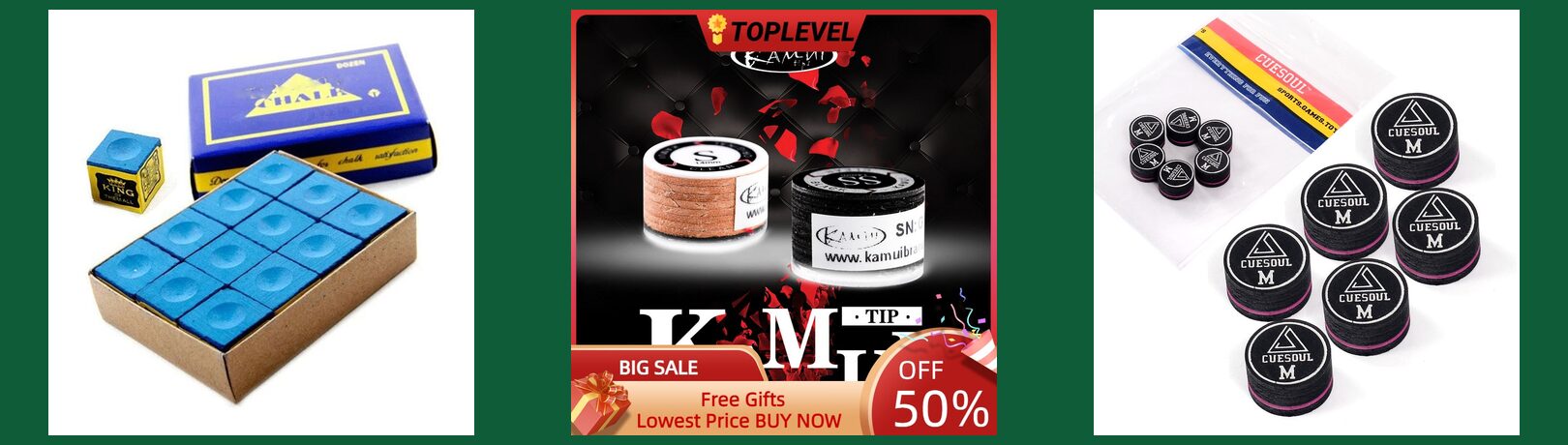
Honest truth first: for the overwhelming majority of players, an inexpensive cube does the job perfectly well. A multipack like the 4pcs Cheap Billiards Snooker Cue Chalk Billiard No-slip Chalk Indoor Sport Accessories gives you spares for your case, your car and your practice table, so you're never caught without one. Where more expensive chalks earn their reputation is consistency of grip and cleaner application — useful if you play long sessions or use a lot of side. But you don't need a premium cube to play good snooker.
A few sensible pointers when picking chalk:
- Match the colour to your cloth. Traditional green blends into a snooker table and hides deposits. Blue is more common on pool cloth. This is cosmetic, not performance — but it keeps the table looking tidy.
- Grip over grade. The best chalk is simply the one that fills your tip evenly and holds. If your current cube leaves patches, it may be too hard or too polished.
- Buy in small quantities. Chalk is cheap and doesn't improve with age. A couple of fresh cubes beats one you've been scraping down to a sliver for two years.
How to Apply It Properly
Application is where most casual players quietly go wrong. You want to brush the chalk across the tip, not drill a hole into the cube. Turn the cue slightly as you go so the whole tip face is coated, paying attention to the edges — that's where miscues start. A light, even layer is all you need.
Two habits worth building:
- Chalk before shots that use spin, every time. The higher the risk of slip, the more it matters.
- Never hold the cube over the table and shake it — you'll dust the cloth and the balls, which affects roll.
Your Tip and Your Chalk Are a Team
Chalk can only work with a tip that holds it. A properly domed, slightly roughened tip grips chalk far better than a smooth, glazed one. If you're miscuing despite chalking well, the tip is usually the culprit.
Layered tips such as the Japanese Original KAMUI Clear Cue Tips Billiard Pool Cue KAMUI Tip 14mm SS/S/M/H Snooker Tip Brown 11mm M/MH Billiard Accessory hold their shape and take chalk consistently, which is part of why they're popular. If you prefer a more traditional feel, pressed pigskin options like the CUESOUL 6pcs/set 14MM Baked Pig Suede Billiard Snooker Cue Tip & Pool Cue Tip are a sensible upgrade over the tip on many budget cues. For a spare table or a knockabout stick, even a bag of the keeps everyone playing. A lightly abraded tip surface takes chalk best — a quick scuff, not a savaging.
Chalk-Related Kit Worth a Look
These are all affordable, mostly imported items — set your expectations accordingly. They won't feel like boutique gear, but they do the job for the money.
A couple of quiet allies here. A 1/2/3pcs Professional Billiard Pool Cue Burnisher Cleaner Polisher Home Cleaning Snooker Pole Training Pool Ball Accessories helps keep the shaft clean, so chalk dust that migrates down the cue doesn't turn into grime that snags your bridge hand. And if your bridge gets sticky in a warm room — which makes delivery inconsistent regardless of how well you've chalked — a simple Spandex Snooker Billiard Cue Glove Pool Left Hand Open Three Finger Accessory for Unisex Women and Men 4 Colors 1Pcs restores a smooth, repeatable slide.
Storing Chalk So It Keeps Working
Chalk is affected by damp. A cube left in a cold, humid garage will clump and apply unevenly. Keep spares in your cue case in a small pocket or a container so they don't crumble against your shaft and coat everything in dust. Wipe the tip and ferrule occasionally too — built-up chalk on the ferrule looks scruffy and can affect how cleanly the tip meets the ball.
The Bottom Line
Chalk is the cheapest performance upgrade in the game and the easiest to take for granted. Buy fresh cubes, apply a light and even layer, keep your tip in good order, and store your chalk somewhere dry. Do that and you'll cut out the frustrating, frame-losing miscue that has nothing to do with your talent — and everything to do with the little cube you almost forgot about.