3/4-Jointed vs One-Piece Snooker Cues: The Real Comparison
Published · Updated · Mark O'Sullivan

Neither design plays "better" — the right choice depends on how you travel, store and use your cue, not on myths about feel.
Ask ten club players whether a one-piece or a 3/4-jointed cue is better and you'll get ten confident, contradictory answers. The honest truth is duller and more useful: both formats can play superbly, and the right choice depends far more on your lifestyle — where you play, how you get there, and where the cue lives between frames — than on any secret performance advantage. This guide pulls together everything that actually matters, so you can spend your money once and spend it well.
What the two designs actually are
A one-piece cue is a single, unbroken length of timber from butt to tip, typically around 57 to 58 inches. It's the traditional club cue and, in its purest form, how most professionals learned the game. Nothing interrupts the shaft, so the transfer of energy through the cue is as direct as it gets.
A 3/4-jointed cue has a brass joint set roughly three-quarters of the way up from the tip, so it splits into a longer shaft section and a shorter butt. Crucially, the joint sits well above your bridge hand, keeping the working part of the shaft in one continuous piece. A 1/2-jointed cue, common in budget house and pool cues, splits in the middle instead — cheaper and more portable, but with the joint sitting right where the cue flexes during the stroke, which is why serious snooker players tend to avoid it.
Does the joint really hurt the feel?
This is the question that puts people off jointed cues, and it deserves a straight answer. On a well-made 3/4 cue with a tight, flush joint, the vast majority of players cannot feel a meaningful difference in normal play. The joint sits above the bridge hand and behind most of the vibration path, so the feedback you actually notice comes from the front of the shaft, which is unbroken. In blind tests, most club players simply can't tell once the cue is chalked and in play.
Where the myth has a grain of truth is at the extremes. On a cheap or poorly cut joint, you can get a slight "dead" spot or faint buzz on powerful shots, because the two halves aren't mating perfectly — that's a quality issue, not an inherent flaw of the design. A brass joint also adds a little weight and can nudge the balance point back towards the butt, which is the honest, physical explanation behind most "it just doesn't feel the same" complaints. Many players actually like a touch more butt weight.
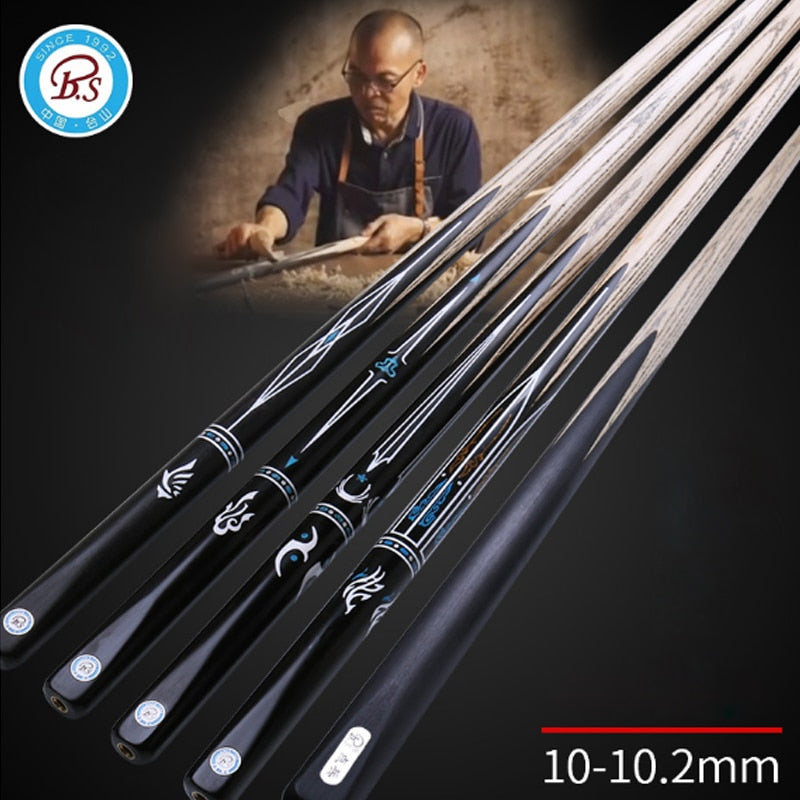
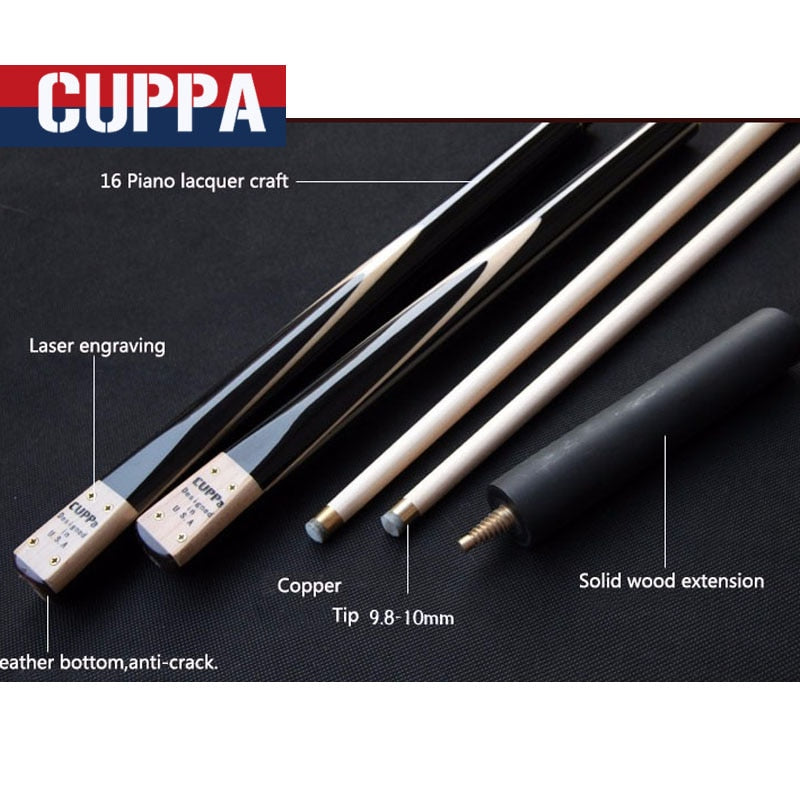
If you're chasing the most unbroken feel possible, a solid one-piece such as the BS New Arrival One Piece Billiard Snooker Cue Stick 10.2mm Tip with Hard Snooker Cue Case Set gives you the traditional experience with a hard case included. But don't assume a joint automatically means a compromised cue — a decent 3/4 such as the NEW Cuppa 3/4 Snooker Cues Stick 9.8mm 11.5mm Tip with Snooker Cue Case Set plays cleanly and comes ready to transport. What matters far more than the joint is the shaft timber, the taper, the tip and the balance — a quality 3/4 cue with good ash and a tidy ferrule will out-play a cheap one-piece every time.
Travel and storage: the real decider
For most people, this single factor decides it before feel even comes into the conversation. A one-piece cue is nearly five feet of rigid timber. Carrying it on a bus, folding it into a hatchback boot or wedging it past a doorway is a genuine faff, and every awkward journey is a chance to knock or warp it. You'll also need a full-length hard case and somewhere at home to store it safely — a wall rack or a corner where it can stand straight and dry, not get leaned against a radiator or wedged in a cupboard.
A 3/4-jointed cue breaks down into two comfortable sections that drop into a compact case, so it travels on the back seat, on a train or over your shoulder without drama. If you play at a club across town, take your cue to a mate's table, or simply don't have a wall long enough for a one-piece, the 3/4 wins before you've even chalked up. A dedicated case such as the Cuppa Handmade 3/4 Snooker Cue Case Set A/B Type Snooker Cues 9.8mm Bright Paint Cracking Prevention Maple Shaft China keeps a jointed cue supported and away from temperature swings between trips.
- One-piece: best if you have a home table or a dedicated locker at your club.
- 3/4-jointed: best if you commute to play, share a car boot with the family shopping, or store your cue in a cupboard.
Extensions and reach
One quiet advantage of the jointed format: because the butt already unscrews, adding an extension for long reaches over the table is straightforward, and many 3/4 cues are built to accept one. The Handmade Cuppa 3/4 Snooker Cues Sticks 9.8mm Tips With Extension Ebony Wood Handle China Anti Cracking Lacquer Craft bundles one in, along with a solid ebony handle. If your jointed cue doesn't include one, a separate Snooker Cue Extender Adjustable Length Telescopic Cue Extension is an inexpensive add-on.
One-piece cues can't accept an integrated extension in the same neat way — a telescopic add-on works if the butt is threaded for it, but otherwise you're reaching for the rest instead. Shorter players, or anyone stretched over the baulk cushion on a full-size table, will get more day-to-day value from the jointed format's flexibility here.
Modern alternatives: carbon shafts
The debate isn't strictly timber versus timber any more. Carbon-composite jointed cues resist warping and behave very consistently shot to shot, which appeals to anyone who dislikes the seasonal moods of natural wood or struggles to store a cue properly. The CUPPA New Arrival Little Monster Carbon Billiard Snooker Cue Stick 10.2mm Tip with Snooker Cue Case Set is a good example — it costs more than a comparable timber cue, and plenty of players still prefer the character of ash or maple, but it neatly sidesteps the old feel-versus-travel compromise. Try one before committing if you can, since carbon feels noticeably different under the bridge hand.
Quick comparison

Picking your first cue: tip, weight and shaft wood
Whatever format you choose, three specifications matter more than the joint question:
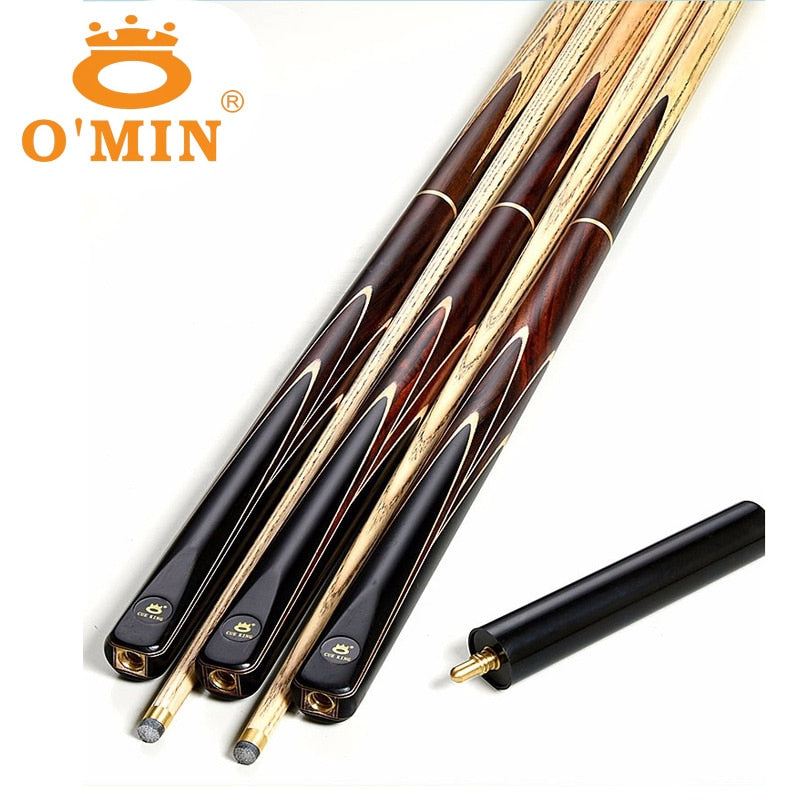
- Tip diameter: snooker cues usually run between 9.5mm and 11.5mm. A smaller tip (around 9.5–10mm) gives more precise cueing on the smaller snooker balls; a slightly larger tip is more forgiving while you learn. The High Quality Omin Handmade 3/4 Snooker Cues Stick Billiard 9.5mm/10mm/11.5mm Tip China gives you a choice of tip sizes if you haven't settled on a preference yet.
- Weight: most cues sit between 17 and 19oz. There's no "correct" weight — heavier cues feel more solid, lighter ones more responsive. Try a friend's cue before deciding if you can.
- Shaft wood: traditional ash shows distinctive arrowhead grain and is the classic snooker choice; maple is paler with a smoother feel. Both work fine for beginners and experienced players alike.
It's easy to fall down a rabbit hole of specifications, but as a beginner your technique will improve far faster than any cue can flatter it. Choose something comfortable, play with it consistently, and only upgrade once you understand what you'd actually want to change. If you're weighing up your very first purchase in more detail, see our guide to common first-cue mistakes.
Setting honest expectations on price and build
Most cues in our catalogue, including the Cuppa and Omin ranges, are imported, hand-finished pieces at accessible prices rather than bench-built British custom cues costing many hundreds of pounds. That's not a criticism — they represent excellent value and play well above their price. What you should expect is a straight shaft, a well-fitted tip, a snug joint with no wobble, and a case that protects the investment. Minor variations in weight, balance and timber grain between individual cues are normal at this level, not a fault.
When a new cue arrives, it's worth checking the joint screws together snugly with no gap at the seam, rolling the shaft on the table to confirm it runs true, and inspecting the tip — many benefit from a light dressing before serious play. None of these are dealbreakers; they're simply the reality of buying at a friendly price, and a cue that's a little rough around the edges on arrival can still play beautifully once set up properly. For more on this, see our cue maintenance and care guide and common cue problems, fixed.
If you're not ready to commit to a full-size cue at all, an inexpensive assemble-yourself set like the 2 Pcs 145cm/57inch American Snooker Wood Pool Cue Assemble Children Adult Home Billiards Exercising Entertaining Tools Supply is fine for casual family games, though its centre joint sits right where the cue flexes, so don't expect refined feel from it. For players who split time between snooker and pool, a versatile jointed option like the CUESOUL 58" 19oz DS Maple Pool Cue Stick Set with 2 Shaft, 13mm Tip Hard Cue Case covers both bases with its wider tip.
Five-minute decision framework
Choose one-piece if…
- You have a home table or secure club storage, and the cue rarely leaves the room.
- You value tradition and want the simplest possible cue, with nothing to check or work loose.
- Transport and storage genuinely aren't a concern for you.
Choose 3/4-jointed if…
- You travel to play, share tables, or store your cue in limited space.
- You want the closest thing to one-piece feel with real-world convenience.
- You'd like a built-in or add-on extension for long, stretched shots.
- You're tempted by a carbon shaft for warp-resistance and consistency on the move.
The honest verdict
For most club and improving players, a 3/4-jointed cue is the practical winner: you keep almost all the feel of a one-piece while gaining a cue you can actually carry, store and extend. The one-piece remains a lovely thing for purists with a settled routine and somewhere safe to keep it. Whichever you choose, buy the best tip, shaft and build quality you can afford, look after it properly, and it will reward you for years — the joint, or lack of one, is rarely what stands between you and a good break.
Frequently asked questions
Does a 3/4 joint make a cue play worse than a one-piece?
Not meaningfully, if it's well made. A tight, flush joint sits above your bridge hand and behind most of the vibration path, so most players cannot tell the difference in blind testing. Cheap or poorly cut joints can cause a faint dead spot on powerful shots, but that's a quality issue rather than a flaw in the 3/4 design itself.
Is a one-piece cue better for beginners?
Only if your circumstances suit it. A one-piece is simpler and gives a direct, consistent feel, which is fine if you have a home table or secure club storage. If you'll be travelling to play, a 3/4-jointed cue is usually the more practical first "proper" cue.
What's the difference between a 3/4 joint and a 1/2 joint?
A 3/4 joint sits high up the shaft, well above the bridge hand, so most of the playing length stays in one piece. A 1/2 joint splits in the middle, right where the cue flexes during the stroke, which is why it's common on budget and pool cues but generally avoided by serious snooker players.
Can I add an extension to a one-piece cue?
Only if the butt is threaded for a telescopic add-on such as the Snooker Cue Extender Adjustable Length Telescopic Cue Extension. Jointed cues make this far more straightforward, since the butt already unscrews, and many 3/4 models include a matching extension in the set.
Are carbon-shaft jointed cues worth the extra cost?
They're worth considering if you value warp-resistance and consistent behaviour over natural timber's character. Carbon feels different under the bridge hand, so try one before buying if possible, and expect to pay more than a comparable ash or maple cue.
What should I check when a new imported cue arrives?
Make sure the joint screws together snugly with no gap or wobble at the seam, roll the shaft on the table to check it runs true, and inspect the tip, since many benefit from dressing before serious play. These checks are normal for cues at this price point and don't indicate a faulty cue.
Do I need a case for a 3/4-jointed cue?
Yes — a compact case is one of the main reasons to choose the jointed format, protecting the cue in a car boot, on a train or over your shoulder. See our guide to choosing the right cue case for more detail on protection and storage.