3/4-Jointed vs One-Piece Cues: A Decision Guide Based on How and Where You Play
· Mark O'Sullivan
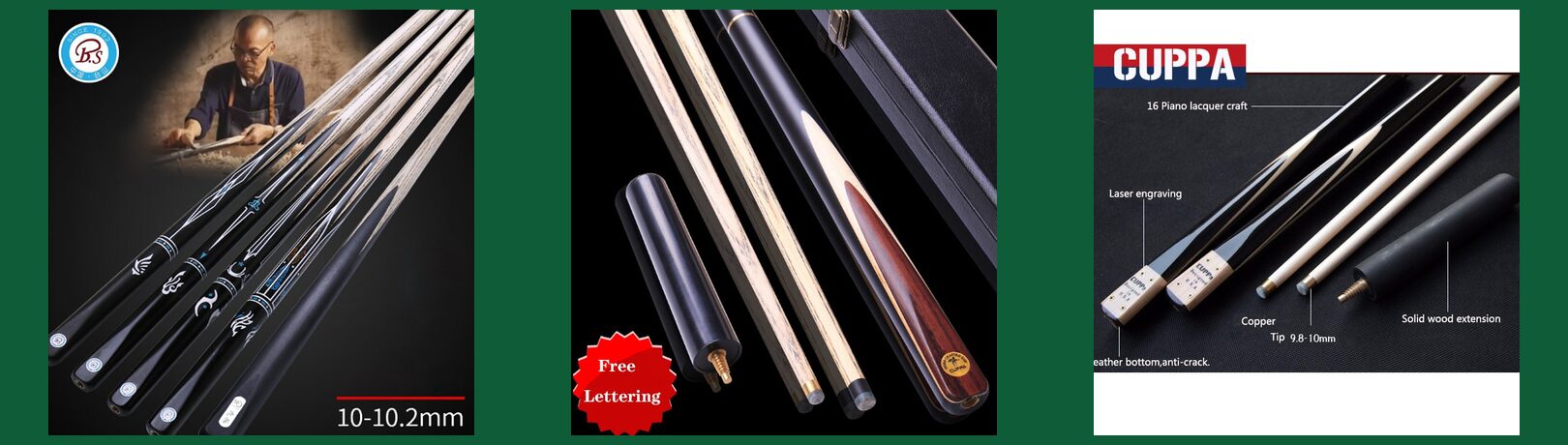
Ask ten snooker players whether a one-piece or 3/4-jointed cue is better and you'll get ten confident, contradictory answers. The honest truth is that neither is objectively superior. The right choice depends less on the cue itself and more on how and where you actually play. So instead of rehashing the usual purist arguments, let's work through the practical questions that genuinely decide it.
Start with the question that matters most: how do you get to the table?
This single factor sorts most players. A one-piece cue is a single 57-inch length that never comes apart. If your table is at home, or your cue lives in a club rack you can reach without a bus ride, a one-piece is a joy — nothing to assemble, nothing to loosen, no joint at all.
The moment you need to carry your cue on public transport, fit it in a car boot, or take it to a mate's house, a one-piece becomes awkward. That's where the 3/4-jointed cue earns its keep: it splits into a longer shaft section and a shorter butt, packing down to roughly two-thirds of full length. Something like the NEW Cuppa 3/4 Snooker Cues Stick 9.8mm 11.5mm Tip with Snooker Cue Case Set gives you a genuine full-size cue that still fits a manageable case.
The feel debate — real, but often overstated
Traditionalists argue that a one-piece transmits cleaner feedback because there's no joint interrupting the timber. There's a grain of truth here. A well-made one-piece like the BS New Arrival One Piece Billiard Snooker Cue Stick 10.2mm Tip with Hard Snooker Cue Case Set does have an uninterrupted, consistent flex from tip to butt.
But modern 3/4 joints, sited high up near the balance point, sit well away from where your bridge hand and the striking action live. In blind tests, most club players simply can't tell the difference once the cue is chalked and in play. If your delivery is smooth and your tip is sound, the joint is rarely what's costing you frames.
Storage, protection and the case question
A one-piece needs a long case and a long space to store it. That's fine at home, less fine in a small flat. A 3/4 stores more compactly and travels safely in a shorter, sturdier tube. Whichever route you take, protection matters more than most beginners realise — a warped shaft is far more damaging than any joint. A dedicated case such as the Cuppa Handmade 3/4 Snooker Cue Case Set A/B Type Snooker Cues 9.8mm Bright Paint Cracking Prevention Maple Shaft China keeps a jointed cue supported and away from temperature swings.
The extension advantage
Here's a point that gets missed: jointed cues make extensions far easier. Because the butt already accepts a joint, adding length for those stretched shots over the baulk cushion is straightforward. Some models come ready for it, like the Handmade Cuppa 3/4 Snooker Cues Sticks 9.8mm Tips With Extension Ebony Wood Handle China Anti Cracking Lacquer Craft, while a separate telescopic option such as the Snooker Cue Extender Adjustable Length Telescopic Cue Extension can be added to most jointed butts. With a true one-piece, your reach options are more limited — you're leaning on the rest more often.
Comparing the practical trade-offs
Here's how the main contenders stack up on the factors that actually influence day-to-day play.
If you want the modern middle ground, carbon-composite jointed cues like the CUPPA New Arrival Little Monster Carbon Billiard Snooker Cue Stick 10.2mm Tip with Snooker Cue Case Set aim to combine portability with a stiff, consistent hit that resists the seasonal movement timber can suffer. It's a pricier route, but it neatly sidesteps the old feel-versus-travel compromise.
A simple decision framework
- Play only at home or one fixed club? A one-piece is the purest, simplest choice — no joint to check, no assembly.
- Travel to venues, or store in a small space? Go 3/4-jointed. The convenience is real and daily.
- Struggle with long reaches? A jointed cue that accepts an extension will make your life easier.
- Worried about warping in a variable climate? A carbon-composite jointed cue is worth the premium.
- On a tight budget? Most affordable jointed cues here play perfectly well; spend the difference on a decent case and tip instead.
Setting honest expectations
Most cues in this range are affordable, imported models. They offer genuinely good value and are more than capable for club and home play, but they aren't hand-turned bespoke cues — expect the odd variation in finish and balance. What you should insist on is a straight shaft, a well-fitted tip and a case that protects your investment. Get those right and, frankly, the joint question becomes a matter of lifestyle rather than performance.
The bottom line
Don't let dogma decide for you. If your cue never leaves the house, enjoy the clean simplicity of a one-piece. If it travels, stores small, or needs to reach across the table, a 3/4-jointed cue is the smarter, more flexible companion. Match the cue to your life, look after it properly, and you'll play better than any joint debate would suggest.