Tube, Box or Wallet? Choosing a Snooker Cue Case That Actually Fits Your Cue
· Mark O'Sullivan
Most players agonise over the cue and treat the case as an afterthought. That's backwards. A cue spends far more time in its case than on the table, and the case is what stands between a well-balanced shaft and the boot of your car, the back seat, the club cloakroom and every knock in between. Get the case right and your cue stays straight, chip-free and ready to play. Get it wrong and you'll be chasing a warped shaft long before its time.
This guide skips the jargon and focuses on the practical question that actually matters: which type of case suits the cue you own — and what details genuinely protect it?
First, match the case to how your cue splits
The single biggest mistake is buying a case that doesn't fit the way your cue comes apart. A one-piece cue and a 3/4-jointed cue have completely different storage needs.
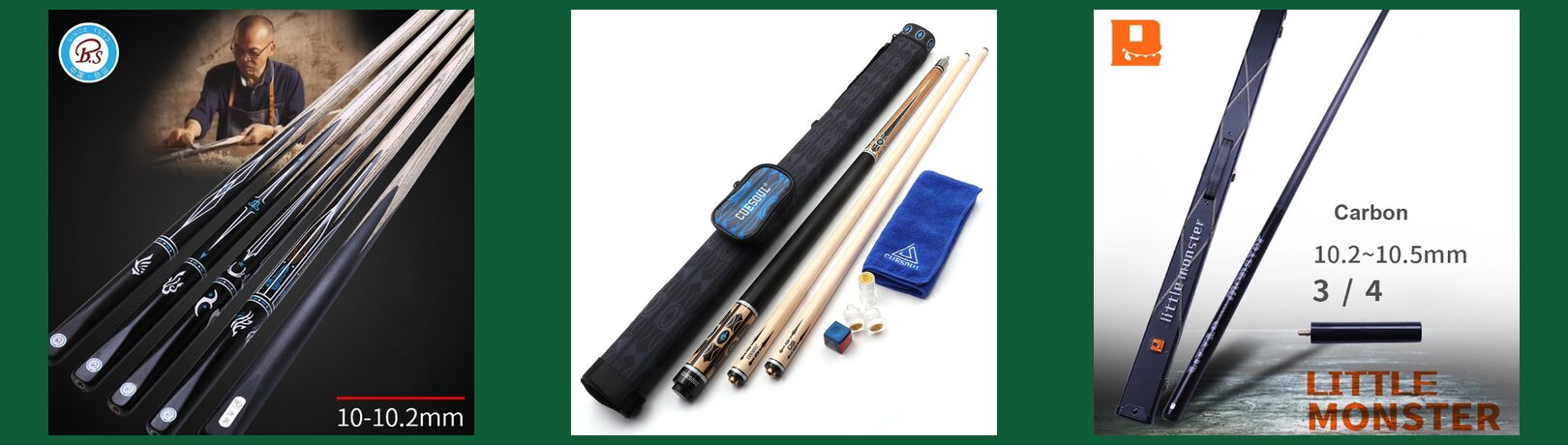
- One-piece or 1/2-jointed cues need a longer case that holds the full length (or two roughly equal halves). A hard tube or box case is ideal here — see the set-up on the BS New Arrival One Piece Billiard Snooker Cue Stick 10.2mm Tip with Hard Snooker Cue Case Set, which pairs a one-piece cue with a rigid case built for that length.
- 3/4-jointed cues break into a short butt and a longer shaft, so they suit a more compact case with two or three tubes — one for the butt, one for the shaft, and often a spare for an extension. The New Handmade Cuppa 3/4 Snooker Cue Stick Billiards 9.8mm Tips 3 4 Snooker Cues Case Set China is a typical example that ships with a case sized to its joint layout.
If you carry a butt extension, check there's a dedicated slot for it. Loose parts rattling against a shaft cause exactly the chips and dinks you're trying to avoid.
Case types explained
Hard box and tube cases
Rigid cases — moulded plastic, aluminium or a stiff shell over board — offer the best crush protection. If your cue ever travels in a car boot or gets stacked under other bags, this is what you want. The trade-off is bulk and weight. Carbon and premium cues in particular deserve a hard shell; the CUPPA New Arrival Little Monster Carbon Billiard Snooker Cue Stick 10.2mm Tip with Snooker Cue Case Set comes as a set precisely because a cue at that level shouldn't rattle around in something flimsy.
Soft wallets and padded tubes
Lighter, cheaper and easier to sling over a shoulder, soft cases are fine for a gentle walk to the local club and back. They resist scuffs but not crushing, so don't rely on them if the cue shares space with heavier gear.
Sets that include a matched case
For most players, buying a cue-and-case set is the sensible move. The case is sized to the cue, the balance is sorted, and you're not guessing at internal dimensions. Two-shaft set-ups like the CUESOUL 58" 19oz DS Maple Pool Cue Stick Set with 2 Shaft,13mm Tip Hard Cue Case 1x1(Cue Set and Cue Shaft only for your choice) show why this matters — extra shafts need their own secured channel, not a shared pocket.
The protection details that actually matter
Beyond the outer shell, it's the inside that keeps a cue straight. Look for these:
- A snug internal fit. The tip and joint should sit firmly with no free movement. A cue that slides inside the case is a cue that gets its tip crushed and its ferrule chipped.
- Padded ends. Foam or a soft cap at the tip end prevents the most common damage of all — a mushroomed or knocked tip.
- A structured, straight body. Cases that let the cue flex or bow while stored can encourage warping over months. Rigidity keeps the shaft dead straight.
- A secure closure. Zips or clasps that actually hold shut, so nothing works loose in transit.
- Somewhere for the small stuff. A pocket for chalk, a spare tip and a mini extension saves you carrying a second bag.
On that last point, if your case has a spare tube, a telescopic Snooker Cue Extender Adjustable Length Telescopic Cue Extension stows neatly and means you're never caught short on long-table shots.
A quick comparison of case-inclusive options
These are all cue-and-case sets, so the case type is built around the cue's format. Use it to picture what suits your own splitting configuration.
Prices and exact materials vary, and most of these are honestly-priced imports rather than boutique British leather cases — so set your expectations accordingly. What you're paying for at this level is a sensible, functional case that fits the cue, not hand-stitched luxury.
Honest expectations
An affordable case won't be a bank-vault. Stitching may be plain, and hardware won't be jewellery-grade. But the fundamentals — a rigid body, a snug fit and a padded tip end — are what keep a cue safe, and those don't require a huge budget. Spend on protection, not decoration. If your cue is inexpensive, a matched set case is plenty. If you've invested in a carbon or handmade cue, step up to the firmest hard case you can, because the case is cheap insurance against a costly warp.
The bottom line
Choose the case around the way your cue comes apart, prioritise a rigid body and a snug internal fit, and make sure the tip end is properly padded. Do that and even a modest case will keep your cue straight and true for years. Everything else — pockets, colour, a bit of branding — is a bonus. Get the fit and the protection right first, and the rest looks after itself.