Snooker Tip Size: 9mm vs 9.5mm vs 10mm Explained
Published · Mark O'Sullivan
Ask ten club players what tip size they use and you'll get answers between 9mm and 10mm — with strong opinions attached. The truth is that snooker tip diameter is a genuine variable that changes how the cue meets the ball, how much spin you can generate, and how forgiving your cue feels on off-centre hits. It's not magic, and it won't fix a wobbly cue action, but it's worth understanding before you buy a cue or re-tip the one you own.
Here's what tip diameter actually does, how it relates to your ferrule, and how to pick a size you'll be happy with for years.
What tip diameter really changes
The tip is the only part of your cue that touches the ball, so its size sets the contact area. A smaller tip presents a smaller, more domed contact patch; a larger tip spreads contact over a wider area. That difference feeds into three things players notice most:
- Spin (side and screw): A smaller tip lets you address the very edge of the cue ball more precisely, so extreme side is easier to reach without slipping off. This is a big reason most professional snooker players sit at the smaller end.
- Cue ball control and "cueing feel": Smaller tips reward accuracy and give crisp, pinpoint contact. Larger tips are more forgiving — a hair off-centre matters less — which suits developing players and anyone who plays casually.
- Miscue margin: A slightly larger tip gives you more room for error when applying side, at the cost of some of that razor-sharp precision.
9mm, 9.5mm and 10mm: who each suits
9mm — precision for the accurate cueist
A 9mm tip is squarely in professional territory. It excels at fine positional play and heavy screw, but it demands a straight, repeatable action — misjudge your contact point and you'll feel it. If your striking is already reliable and you want maximum control over the white, a 9mm cue like the Fury BLUE VANQUISH Ash 3/4 Jointed Pool Snooker Cue 9mm gives you that smaller, sharper contact.
9.5mm — the sensible all-rounder
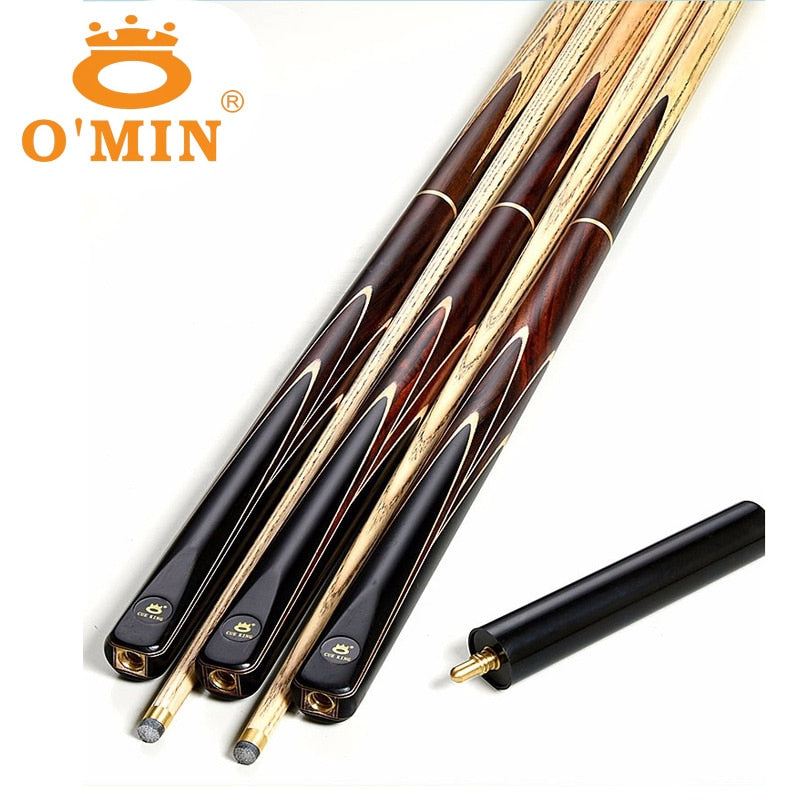
For most improving and club players, 9.5mm is the sweet spot. You keep the vast majority of the precision benefits of a small tip while gaining a touch more forgiveness. It's the diameter I'd point a first-time buyer toward, and cues such as the POWERGLIDE Executive Ash Snooker Cue 3/4 Jointed 17oz 9.5mm arrive at exactly this size. Many cues also ship in a 9.5/10mm bracket, giving you room to settle in — the High Quality Omin Handmade 3/4 Snooker Cues Stick Billiard 9.5mm/10mm/11.5mm Tip China is a good example of that flexibility.
10mm — forgiving and beginner-friendly
A 10mm tip is the most forgiving of the three. Off-centre hits are more consistent, miscues are rarer, and it copes well if your action is still developing or you play a mix of snooker and English pool. The trade-off is slightly less finesse when you're chasing extreme side. It's a perfectly sound choice for casual play and for younger players building confidence.
Ferrule compatibility: the bit people forget
Your tip has to match your ferrule — the (usually) hard collar at the very end of the shaft that the tip glues onto. This matters most when re-tipping:
- Match the tip to the ferrule diameter, not the other way round. A 9.5mm ferrule needs a tip of at least 9.5mm, which you then trim and burnish flush to the sides.
- Always fit slightly oversize, then sand down. A tip a fraction larger than the ferrule can be filed level; a tip smaller than the ferrule leaves an exposed lip that chips and plays badly.
- You can't meaningfully go up in diameter without re-shaping or re-ferruling the shaft — the wood tapers to a fixed point. So if you want a bigger tip, that's really a decision made at cue-buying time.
Glue-on replacement tips are cheap and come sized to suit. For a 10mm ferrule, a pack like Elkmaster glue on snooker / pool cue tips - 10mm x 10 [Misc.] gives you plenty of spares, while Elkmaster Glue on Tips, 9mm (5pcs) covers the smaller end. Whichever you fit, you'll get a cleaner result with a dedicated shaping tool such as the eSynic Snooker Cue Tip Shaper 3-in-1 Pool Cue Tip Shaper to dome and trim the tip properly.
Shape matters as much as size
Don't obsess over the last half-millimetre. A well-maintained tip domed to roughly the curve of an old sixpence (or a 5p coin) will play far better than a perfectly-sized tip that's gone flat and glazed. Keep it shaped, keep it chalked, and keep it slightly rough so chalk holds. A tired 9mm tip will control the ball worse than a fresh, well-domed 10mm one every time.
So which should you choose?
- New to snooker or play casually: go 10mm, or 9.5mm if you want to grow into it.
- Club player working on your game: 9.5mm is the safe, versatile default.
- Confident, accurate cueist chasing maximum spin and touch: 9mm rewards you.
Above all, be honest about your action. Tip diameter is a refinement, not a shortcut. Pick a size that suits where your cueing is now, keep it well shaped and chalked, and you'll get far more from it than from chasing whatever the pros happen to use.
The bottom line
9mm gives precision, 10mm gives forgiveness, and 9.5mm splits the difference — which is why it's the most popular choice for good reason. Match your tip to your ferrule when re-tipping, always fit a shade oversize and sand flush, and maintain the dome. Get those basics right and any of the three sizes will serve you well.